Research Workflow & Focusing Matrix
When it comes to gig-based work and task-taking, I have to figure out what gives me the most friction and will cause a literal mental blocker. So I’ve started to only accept projects that score well on four axes: Cognition, Creativity, Mobility, and Traction.
I just enjoy anything that requires having a problem, collecting data, finding a solution, seeing if it works, then iterating.
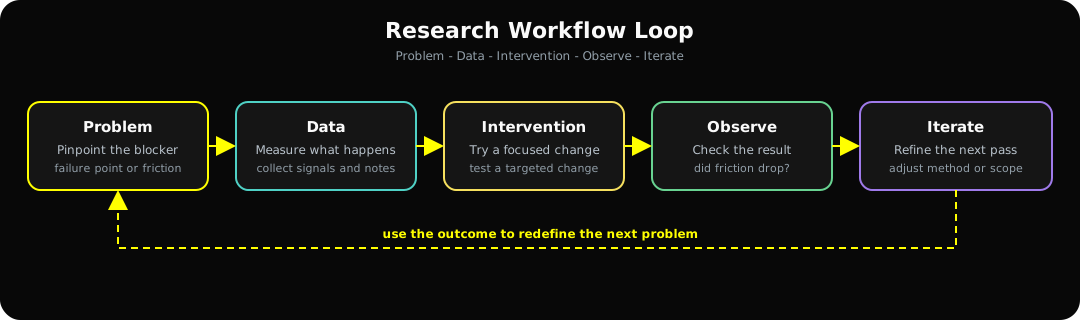
To clarify upfront: I have ADHD Combined Type along with OCD. Currently I had been on the Wellbutrin -> Strattera pipeline, which usually has no effect, then works, until overtime it suddenly doesn’t. More on why that is at the bottom. I’m using myself as a standalone case study for this, and this will be continually updated based on experiences. My blog post for this was initially on Substack on Nov. 2025.
The CCMT Framework
The framework is simple:
- Cognition: Low (repetitive) <-> High (complex reasoning)
- Creativity: Low (rigid rules) <-> High (novel solutions)
- Mobility: Low (desk-bound) <-> High (physical/contextual variety)
- Traction: Low (no domain hook, deferred until necessary) <-> High (existing interest plus domain familiarity, picked first and sustained longest)
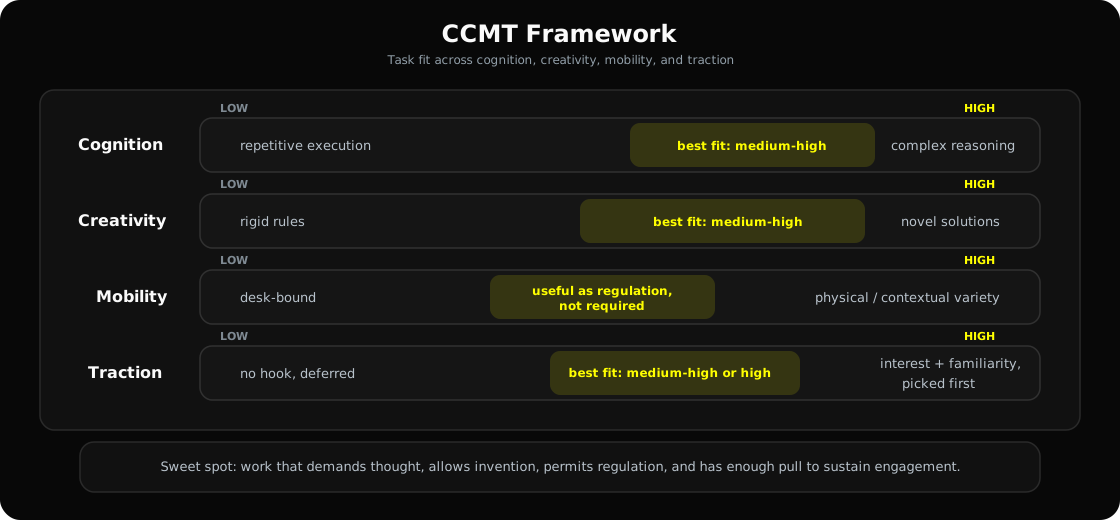
Typically, to feel productive and work well, I need a job that sits at medium to high cognition and medium to high creativity. The sweet spot is finding what aligns with how my brain actually processes information and what produces dopamine, rather than fighting against it. The more restricts and “guardrails” if we are to using machine learning in deep learning as terminology, hurts the potential for creativity and forces procedural but task-instanced workflow that lasts so as long as the cognitive debt lasts.
A note on Mobility: this axis is slightly inverted for me in practice. I’m naturally a high-mobility person, I genuinely love movement, obstacle courses, physical play, but circumstance keeps me desk-bound. What I’ve found is that high-mobility tasks aren’t necessarily required, but physical movement acts as a nervous system regulator that offsets cognitive friction. A standing treadmill during low-stakes tasks does more for my focus than sitting still ever will. The mobility axis is less about job type and more about whether my body has somewhere to put the excess energy that isn’t just bouncing off the walls of my brain.
Traction is the new part. It is not just novelty, and it is not just importance. It is the composite of intrinsic interest plus domain familiarity that determines where a task sits in the priority queue. High-traction work gets picked first, sustains longer, and usually spills past the minimum task boundary into actual learning. Low-traction work gets deferred until there is nothing else left, and even then it usually gets done in the most minimal, debt-heavy way possible.
So the axis is less “will I do this at all?” and more “where does this task sit in the interest queue relative to what I already care about and understand?” For me, that pull is clearly structured by prior interest and prior knowledge. A task with no hook is usually ignored. A task with partial overlap can ramp. A task with strong overlap can become a multi-hour research block without much friction at all.
The practical gradient looks like this:
- High traction: deep existing interest plus domain knowledge; picked first, sustains longest, propagates beyond the task boundary
- Medium traction: partial investment plus some domain contact; picked when the higher-priority work is cleared, but still generates extra-task learning
- Low traction: no existing interest, no domain hook; deferred until the queue is otherwise empty, minimal propagation, high cognitive debt
Duration, Breaks, and Cognitive Debt
There is still the time constraint. The on-ramp in a workflow does make it easier once started, but there are diminishing returns. If a task takes longer than an hour, intermission time becomes necessary between tasks, which is close to the Pomodoro technique in practice.
The pattern I’ve found:
- Medium-high cognition, low creativity: cognitive debt scales with task length. Breaks are required and the break duration scales with how long the task took. Audio transcription work has a bleed effect; once disengaged, it bleeds into rest time.
- High creativity, medium cognition, with high traction and a desired result: the only condition where I can sustain 3+ hours straight. This is when ADHD becomes a feature rather than a bug.
The more normalized the task and more towards the pattern that I work well in, the less overall ramp up and intermission time between tasks that is needed until it becomes a focused state of time to work; however this is only when it’s a high synergy + potential for things that interest me related to the task.
A full 8+ hour productive day is achievable, but only if the work is correctly matched to how the brain processes it. As it stands, when it comes to pure research based tasks, I can go well and beyond 8 hours of productivity.
Why Traction Matters
The best example I have is a comparative evaluation involving precision fermentation. On paper, that was not my field. But it already overlapped with something I had been doing on my own: min-maxing protein intake, using whey supplements plus Fairlife shakes to keep a baseline of about 50g a day, and staying consistent with that for about two months because I felt amazing on it. A few months later, I had to research precision-fermentation dairy proteins, so the task already had a real hook before I even opened it.
That is why the evaluation did not stay inside the evaluation. It propagated.
I ended up going deeper into:
- the NOVA scale and food processing
- cross-species milk comparisons across cow, goat, and sheep
- the difference between protein quantity and the broader food matrix
- the practical difference between whole-food-adjacent products and what I ended up thinking of as biofabricated synthesized proteins
Footnote: the NOVA scale is a food-classification system that ranges from minimally processed foods to ultra-processed foods.
The actual conclusion was broader than the evaluation prompt. I ended up deciding that foods outside of whole-food structure are usually worse unless they are paired with whole foods, because the food matrix matters. Cow milk is the general baseline. Sheep milk looks like the strongest general option on paper. Goat milk is often the easier step up from cow, especially on micronutrients, and seems better suited to recovery than either sheep or cow.
I also looked at how the cheapest non-animal versions are often made by feeding bacteria sugars, which made me more skeptical of the whole setup in practice. That pushed me toward a simple rule: if a product is naturally animal-derived, I would rather get the actual version than the vegan imitation. Feta is an easy example of that. A lot of generic store options are not actually sheep- or goat-based in the first place.
That is the useful signal. The task itself was medium traction, not a lifelong obsession and not a dead-zone task either. It had partial investment plus enough domain contact to turn into domain acquisition instead of bare completion. If you can tell from the chain above, I learned a lot because the task already had somewhere to attach.
That is why I do not think this axis should be called novelty. Low novelty can still have high traction if it sits inside an existing interest gradient. High novelty with no hook usually does nothing for me. Traction is the better word because it captures whether a task actually grips and keeps moving.
Task Friction Analysis
One task I’ve recently encountered with a lot of friction is detailed evidence-based captioning with heavy restrictions and strict completion guidelines. By the framework this is low-med cognition, low creativity, and low traction. I can do about 4 before hitting an implicit wall that proves impassable and it gets worse every time new rules get added on top of existing ones. The cognitive overhead of holding an ever-expanding ruleset while also doing the task itself is its own separate tax.
Comparative evals are a useful contrast. High cognition, low creativity on paper — but they work better for me for a few reasons. Quality matters more than speed, so there’s no artificial time pressure compressing my ramp-up. I can filter by what actually interests me topic-wise, which removes a friction layer before I even start. And the guidelines are usually lean enough that I’m not cross-referencing a living document mid-task. In CCMT terms, they often land medium or high on traction even when creativity is only moderate.
Unnecessary friction compounds fast. A task that requires converting foreign currency and navigating region-restricted websites isn’t just slightly harder — it’s two extra layers of overhead that eat into the working memory budget before the actual work begins. That budget isn’t unlimited.
The pattern I’ve noticed is that tasks optimizing for completion volume over quality are consistently the hardest for me. They tend to have the most rules, the least ramp-up tolerance, and the fastest diminishing returns. When one task’s internal documentation spans 6+ pages of dos, don’ts, updates to the don’ts, and separate reviewer guidelines: that’s not just a task, that’s a context switch you never fully recover from — and it’s more than gig work, because you have to treat it like FTE hours, but you aren’t salaried.
Why This Works the Way It Does — Pharmacogenomics
This section added on: 3/10/2026
This is still a proposed framework in a blog, with a sample size of one, and I am also the subject. That is not me trying to smuggle this in as formal research. It is just the most honest methodology statement available for where this currently lives.
I recently went down a rabbit hole on my pharmacogenomics after cross-referencing my 23andMe and AncestryDNA reports. Turns out I have COMT Val/Val (rs4680), which means I’m a fast dopamine metabolizer — my brain degrades dopamine faster than average. This explains a lot about why the Wellbutrin -> Strattera pipeline either never worked or stopped working. You can’t recycle dopamine more efficiently if it’s already gone.
I also have rs6269 and rs4633 alongside the Val/Val, which compounds this further.
The fun doesn’t stop there. I have MTHFR C677T (rs1801133), which reduces how efficiently I process folate — and folate is upstream of both dopamine and serotonin synthesis. So before the fast degradation even kicks in, I may just be producing less to begin with.
And then there’s CYP2C9*3 (rs1057910), which makes me an intermediate metabolizer for certain medications — meaning some drugs process more slowly in my system and can accumulate to higher-than-expected levels. So I potentially have both ends of the problem simultaneously: dopamine gets burned through fast, some meds linger longer than they should, and baseline neurotransmitter production is already reduced upstream.
All of which is to say: if your meds feel like they’re not doing anything, or work and then suddenly stop — it might not be tolerance or placebo. It might just be your genes. It’s worth looking into and also with a professional.
I also have the ACTN3 R577X variant (rs1815739), homozygous RR — the full sprinter/power genotype. Both fast-twitch muscle fiber expression copies are functional. The obstacle course obsession makes complete biological sense in retrospect. Circumstance just got in the way.
Changelist
- Added citations for the SNP variants
- Further improved the CCM Framewok to be a much better visual.
- After some thought, the traction part was added because it felt like the “CCM Framework” was inherently missing something
- Improved general readability of the blog post.