Agentic AI from First Principles
While working through GOAM, I ended up arriving at my own practical model of agentic AI from systems design rather than from agent literature first. I was not trying to “get into agentics.” I was trying to understand what the machine had to do structurally in order to keep acting across multiple steps without collapsing into a single inference.
That question reduces cleanly to a loop.
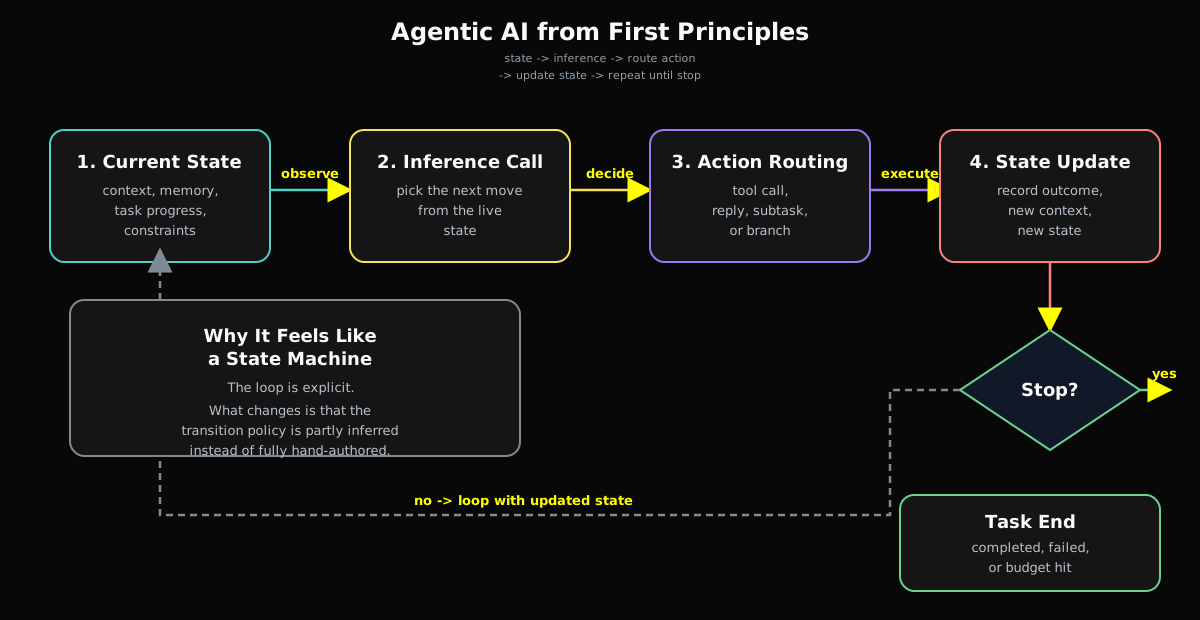
At first principles, the structure is:
- Read the current state.
- Run inference for the next action.
- Route that action to the right output, tool, or sub-process.
- Update the state.
- Repeat until the stop condition is reached.
That is why agentic AI felt familiar to me almost immediately. If you have already spent enough time building state machines, mission logic, branching systems, or control loops, the skeleton is not alien. The difference is that the transition policy is no longer fully hand-authored. Part of it is inferred at runtime.
The Core Loop
The compressed version is still straightforward:
- state
- inference
- action routing
- state update
- repeat until done
For an LLM agent, the model is selecting the next move from the current context window plus whatever memory, tool traces, or intermediate state were preserved. For a neural or planner-style agent more broadly, the same loop still exists. What changes is the policy source, not the existence of the loop itself.
That is why the most useful reduction I have for these systems is still this: they are state machines where the transition function is partly learned or inferred.
Why GOAM Landed Naturally
GOAM made sense to me because the architecture was already close to this shape. There were states, allowed actions, routing paths, failure conditions, and continuation logic. The design questions were familiar:
- what state is the agent in
- what actions are valid right now
- where does the chosen action get routed
- what changes after the action resolves
- what counts as completion
That framing is still more useful to me than vague language about autonomy. It forces the system back into operational terms.
Runtime Is the Loop Spending Budget
The runtime side is not especially mysterious either.
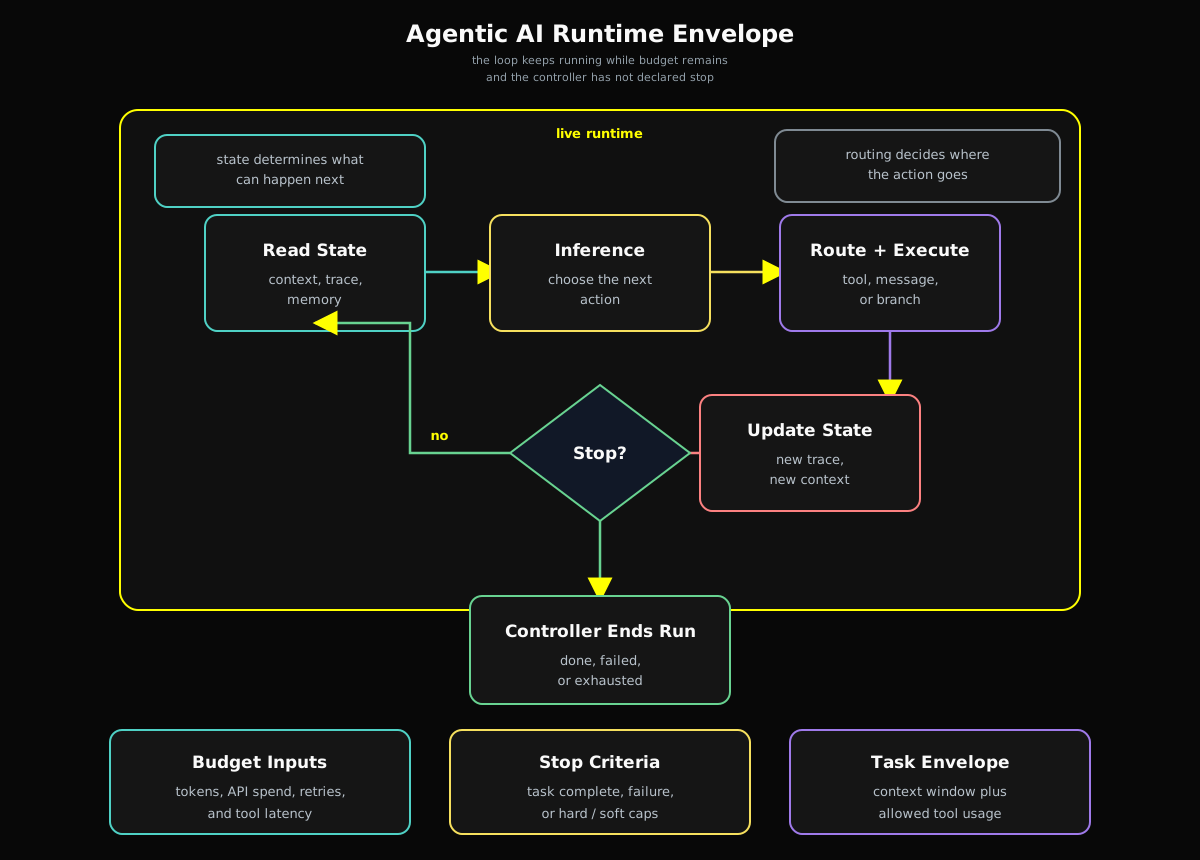
The loop continues while budget remains and the stop condition has not been met. In practice, that budget is some mixture of:
- token budget
- turn budget
- tool latency
- API usage
- controller-specific stop criteria
In that framing, the task is not just a prompt. The task is the active context plus the execution envelope attached to it. What the system can do at any step is constrained by what state it still retains, what tools it is allowed to call, and what budget remains for another inference cycle.
That is also where controller logic matters. A system does not need to wait for total exhaustion. It can monitor derivative spend and branch early. If a controller has already burned too much of the available budget, it can stop, switch to a cheaper path, reduce tool calls, or permit one final pass only if completion is close enough.
The Structural Point
If I compress the whole thing as far as possible, my first-principles view is still this:
Agentic AI is state, inference, routing, and update in a loop until stop.
That is not the full academic taxonomy. It is the structural minimum that made the rest of the field click for me.